Door Hardware Selector Guide
Door Hardware Selector Guide
Choosing the right door hardware involves several decisions. Work through each step below to narrow down exactly what you need — and find the right product for your door.
Step 1 — What Kind of Door Are You Hardwaring?
Start by identifying your door type, as this determines which hardware categories apply to you.
- Single hinged entry door → Proceed to Step 2
- Double (French) door set → You will need hardware for both an active door and an inactive door (or a dummy trim). See Step 3.
- Sliding patio or glass door → Browse our Sliding Glass Patio Door Hardware section.
- Pocket, closet, or bypass door → Browse our Pocket Door and Closet Door hardware sections.
Step 2 — Cylinder Configuration: Single vs. Double Cylinder
The cylinder is the part of a deadbolt or lockset that accepts a key.
| Configuration | How it works | Best for |
|---|---|---|
| Single Cylinder | Key on the exterior; thumb-turn on the interior | Most residential entry doors where quick egress (exit) is important |
| Double Cylinder | Key required on both sides | Doors with glass panels near the lock (prevents reach-through entry); note that double cylinders can slow egress in an emergency |
Safety note: Double-cylinder deadbolts may be restricted or require specific egress provisions under local building and fire codes. Always check your local code requirements before installing a double-cylinder lock. We recommend consulting a licensed locksmith or building official for guidance specific to your location.
Browse our Deadbolt Locks Collection →
Step 3 — Active, Inactive, or Dummy Hardware?
This is the most common source of confusion for double-door sets. Here's how to tell them apart:
| Hardware Type | What it does | When you need it |
|---|---|---|
| Active | Fully functional — includes a working latch, lock, and/or key cylinder | The door that opens and closes regularly; every single door needs one active set |
| Inactive (Passive) | Includes a flush bolt or multi-point mechanism to hold the door stationary, but no separate lockable cylinder | The stationary (less-used) panel in a double-door set — keeps the door fixed in place without its own deadbolt |
| Dummy Trim | Decorative handle only — no latch, no lock, does not operate the door | Closet doors, French door panels that swing open together, or anywhere you want a matching handle with no mechanical function |
Quick rule: A standard double-door set typically requires one active set + one inactive set. A pair of closet doors or a door with a stationary decorative panel typically requires one active set + one dummy set.
Shop by Hardware Type
- Dallas Series — Active
- Dallas Series — Inactive
- Dallas Series — Dummy
- Ashland Sentinel 1⅝" — Active
- Ashland Sentinel 1⅝" — Inactive
- Amesbury Gemini / Truth Nexus 1⅝" — Active
- Amesbury Gemini / Truth Nexus 1⅝" — Inactive
- Multipoint Lock Handle Set Trim
Step 4 — Mortise vs. Cylindrical (Bored) Fit
Before ordering, confirm which lock prep (cutout) your door has.
| Type | Description | Common applications |
|---|---|---|
| Mortise | Large rectangular pocket cut into the edge of the door; the lock body sits inside the door | Commercial doors, older residential homes, high-security applications, most European-style doors |
| Cylindrical (Bored) | Round cross-bore hole through the face of the door with a smaller latch bore on the edge | Most modern North American residential doors; standard knob and lever sets |
Tip: If your door has a large rectangular pocket on the edge, you need a mortise lock. If it has two round holes (one through the face, one on the edge), it is a cylindrical prep.
Browse Mortise Locks & Cylinders →
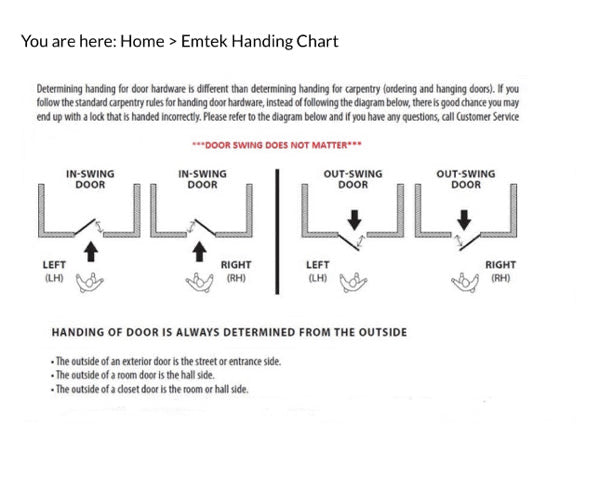
Step 5 — Door Handedness
Handedness describes which side the hinges are on and which way the door swings. To determine yours:
- Stand on the outside (key/exterior side) of the door, facing it.
- If the hinges are on your left, you have a left-hand door.
- If the hinges are on your right, you have a right-hand door.
Swing direction also matters — inswing doors open toward you; outswing doors push away. Many multi-point lock handle sets are handed, so confirm before ordering.
Step 6 — Backset
The backset is the distance from the edge of the door to the center of the bore hole.
- 2-3/8" backset — Standard for many interior and lightweight exterior doors
- 2-3/4" backset — Most common for exterior residential doors in North America
- Other backsets — Some commercial, mortise, and multi-point locks have different requirements; measure carefully before ordering
Browse 2" Backset Locks & Deadbolts →
Step 7 — Finish Matching
Mismatched finishes are a common afterthought. For a cohesive look, consider matching or coordinating finishes across your deadbolt, handleset, hinges, and strike plates.
- Satin Nickel (US15 / 619) — Cool grey tone; very popular in modern and transitional homes
- Oil-Rubbed Bronze (US10B / 613) — Dark, warm tone with subtle highlights; suits traditional and Craftsman styles
- Antique Brass (US5 / 605) — Warm gold tone; classic and formal
- Polished Chrome (US26 / 625) — Bright silver; clean and contemporary
- Matte Black (US19) — Bold and modern; popular in contemporary and farmhouse aesthetics
- Stainless Steel — Durable and corrosion-resistant; common in coastal or high-traffic applications
Tip: Most brands offer the same product in multiple finishes. Order finish samples or check brand finish-matching guides when coordinating across manufacturers.
Still Not Sure? Browse by Door System
Many of our handle set families are organized by door system with Active, Inactive, and Dummy options grouped together. Start here:
- All Door Parts & Hardware
- Hinged Residential Doors
- Multipoint Locks
- Multipoint Lock Handle Set Trim
- HOPPE Locks & Handle Sets
- Emtek Hardware
- Schlage Hardware
- Baldwin Hardware
- Mortise Locks & Cylinders
- Deadbolt Locks
Need help deciding? Contact our team — our specialists can help you find the right hardware for your specific door and application.